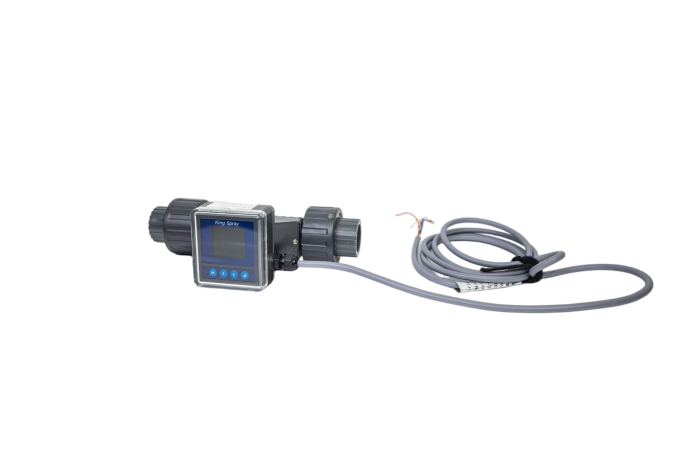
In industrial production, scientific research, and many aspects of daily life, flow meters play a crucial role. They are used to measure the flow of fluids (liquid, gas, or steam), helping us accurately control the transportation of fluids, thereby ensuring the stable and efficient operation of production processes, as well as the accuracy and reliability of various fluid measurement scenarios. This article provides a detailed analysis of the common classifications of flow meters and their characteristics.
The ultrasonic flow meter uses the characteristics of ultrasonic waves propagating through the fluid to measure flow. According to different measurement principles, it can be divided into transit-time and Doppler methods among others.
The transit-time ultrasonic flow meter from the professional ultrasonic flow meter manufacturers calculates the fluid’s velocity by measuring the time difference of ultrasonic waves traveling downstream and upstream, and thus obtaining the flow rate.
The Doppler ultrasonic flow meter measures flow velocity by detecting the Doppler shift of the ultrasonic waves scattered by particles or bubbles in the fluid.
For water measurement applications, an ultrasonic water meter clamp on solution has the characteristic of non-contact measurement, does not need to be inserted inside the fluid pipeline, and does not produce resistance to the fluid flow within the pipeline, thus not changing the flow state of the fluid and causing no pressure loss.
Additionally, they can measure various fluids, including liquids, gases, and fluids containing a certain amount of impurities, with a measurement accuracy generally between ±1% to ±2%. However, the measurement accuracy of ultrasonic flow meters may be affected by the acoustic characteristics of the fluid, pipeline material, installation position, etc., and their accuracy may decrease during low flow measurements.
The thermal flow meter operates based on the principle of heat exchange. It calculates the fluid flow rate by measuring the amount of heat carried away by the fluid flowing through the heating element. Thermal flow meters typically use either the constant temperature difference method or the constant power method for measurement.
In the constant temperature difference method, the temperature difference between the heating element and the fluid is kept constant, and the flow rate is calculated by measuring the power needed to maintain the constant temperature difference. In the constant power method, the power of the heating element is kept constant, and the flow rate is calculated by measuring the temperature difference change caused by the fluid flowing through the heating element.
Thermal flow meters have high measurement accuracy, especially in measuring small flow rates of gases, such as in laboratory gas flow measurements and gas flow control in semiconductor manufacturing processes. However, their response speed is relatively slow and they are sensitive to changes in fluid temperature, requiring temperature compensation to maintain measurement accuracy.
The vortex flow meter measures flow based on the principle of fluid generating alternating vortex streets (i.e., Kármán vortex streets) when flowing past a bluff body. The shedding frequency of the vortices is proportional to the flow velocity of the fluid. By detecting the shedding frequency of the vortices, the flow rate of the fluid can be obtained.
Vortex flow meters have the advantages of simple structure, easy installation, and wide measurement range, with a measurement accuracy generally between ±1% to ±1.5%. They are suitable for the measurement of various fluids, including liquids, gases, and steam, and are not affected by factors such as fluid density and viscosity. However, vortex flow meters are sensitive to pipeline vibrations. Large vibrations may interfere with the vortex shedding frequency, affecting the measurement accuracy, thus it is necessary to avoid vibration sources as much as possible during installation.
The differential pressure flow meter measures fluid flow based on the principle of Bernoulli's theorem and the continuity equation. When fluid passes through a restriction device, a pressure difference is created before and after the restriction, which has a defined relationship with the flow rate of the fluid. By detecting the pressure difference, the fluid flow can be indirectly obtained. Specifically, the differential pressure flow meter transforms the flow rate into a differential pressure signal using a throttling element. When fluid flows through the throttling element, local contraction occurs around it, causing an increase in flow velocity and a decrease in static pressure. The static pressure difference created across the throttling element has a certain functional relationship with the flow rate. By measuring the differential pressure and calculating the flow rate using corresponding flow equations or calibration curves, the flow rate of the fluid can be determined.
Differential pressure flow meters have the advantages of a wide measurement range, high measurement accuracy, simple structure, and low cost. However, they also present significant pressure losses, sensitivity to fluid properties, and are not suitable for high-viscosity media and low flow rate measurements. In practical applications, the appropriate differential pressure flow meter should be selected based on the specific flow requirements and properties of the fluid.
The working principle of the rotameter by the rotameter flow meter manufacturers is based on constant differential pressure and variable throttle area method. It mainly consists of a tapered glass tube (with an angle of about 4°) and a solid rotor (float) with a density higher than that of the fluid being measured. When fluid enters from the bottom of the glass tube, it passes through the narrow annulus between the float and the tube wall and exits from the top. As the fluid flows through the annulus, the flow cross-sectional area continuously decreases, increasing the flow velocity and reducing the pressure. This creates a pressure difference (△P=P1-P2) at the top and bottom of the float, generating an upward lift (F1) on the float.
As the float ascends, the annulus area increases, reducing the flow velocity and increasing the pressure. This reduces the pressure difference across the float. Simultaneously, the float is subject to a downward force (F2), such as gravity. When F1 and F2 balance, the float stabilizes at a certain position. The flow value can be read based on the position of the float's upper plane relative to the scale marked on the outer surface of the glass tube, determining the corresponding flow rate.
In summary, there are many types of flow meter, each with its unique measurement principle, characteristics, and applicable range. In practical applications, it is essential to choose the appropriate type of flow meter based on specific measurement objects, measurement requirements, on-site conditions, etc., to ensure the accuracy and reliability of flow measurements, providing robust support to industrial production, scientific research, and various aspects of social life.
With continuous technological advancements, flow meter technology is also evolving and improving, and more high-performance, intelligent flow meter products will emerge in the future to meet the growing demand for flow measurement.

 English