The spray nozzle is a crucial component in many types of equipment for spraying, misting, oil spraying, sandblasting, and coating, playing an important role.
Industrial nozzles need maintenance, regular inspection, cleaning, and even replacement to ensure the final product quality and maintain the economic efficiency of the production process. Customers can schedule regular maintenance or replacement based on the nozzle's purpose, the liquid being sprayed, and the nozzle material.
If the nozzle is indeed clogged, it can only be cleaned with a soft brush or toothpick, and the cleaning process must be very careful. Even using a wooden toothpick to clean the nozzle opening can potentially distort the orifice.
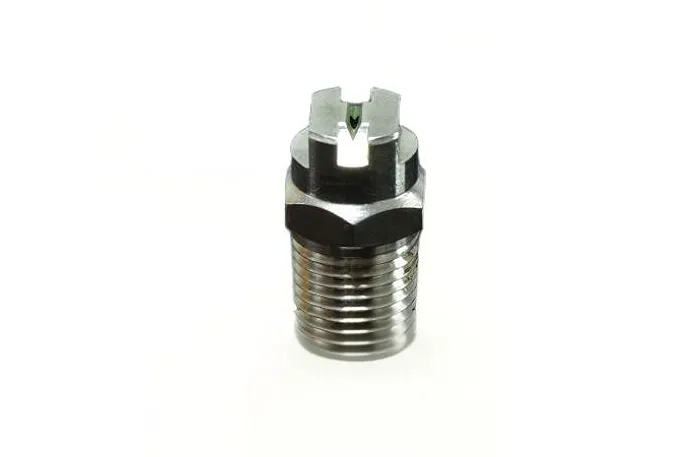
Nozzle accessories include pipe thread fittings, solenoid valves, liquid filters, and pressure gauge fittings.
Nozzles can be divided into two main categories: burner nozzles (military, civilian) and non-burner nozzles;
Based on the function of the nozzle, they can be roughly divided into: spray nozzles, oil spray nozzles, sandblast nozzles, and special nozzles.
By material classification, they can be divided into: metal nozzle, plastic nozzle, ceramic nozzle, and alloy nozzle.
If the application environment requires corrosion resistance, metal material nozzles should be avoided. For strong corrosive media like sulfuric acid and hydrochloric acid, nylon plastic nozzles can be used. Stainless steel materials can also effectively prevent rust.
By industry classification, they can be divided into: petrochemical nozzles, agricultural nozzles, textile nozzles, paper nozzles, printing nozzles, environmental (desulfurization, denitrification, nitrogen removal, dust removal, etc.) nozzles, coating nozzles, steel metallurgy nozzles, electronic nozzles, food nozzles.
By shape classification, they can be divided into hollow cone nozzles, solid cone nozzle, square nozzle, rectangular nozzle, oval nozzle, fan nozzle, column (straight) nozzle, dual-fluid nozzle, multi-fluid nozzle, etc.
In various factories and equipment around the world, nozzles need to perform a variety of tasks. However, when studying nozzle performance, it is essential to understand the five common functions that nozzles need to have:
Meet liquid flow requirements: At a certain pressure, the nozzle must provide a specific flow rate. Flow rate is usually expressed in liters/minute (L/min).
Create spray patterns: Common spray patterns include full cone, hollow cone, fan, and needle shapes.
Produce atomized particles: Depending on the liquid being sprayed, the nozzle type, flow rate, and pressure, the range of atomized particles can be 20~10000um.
Generate impact force: Impact force refers to the force with which the spray hits the target surface, expressed in kilograms-force per square centimeter (MPa). It depends on many factors, including flow rate, spray shape, nozzle type, spray distance, and pressure.
Provide spray velocity: Liquid pressure is converted into a high-speed jet forming a certain velocity, expressed in meters/second (m/s). High-pressure cleaning; scale removal in steel rolling, and gas cooling all have specific velocity requirements for the liquid.
Industrial nozzles have a wide range of applications in industries, with materials ranging from stainless steel, plastic to silicon carbide, PTFE, PP (engineering plastic), aluminum alloy, and tungsten steel.
Generally speaking, spray applications can be divided into the following four categories:
Cleaning, rinsing, and washing: Includes high-pressure descaling during the hot rolling process, as well as medium-to-high-pressure cleaning of products, cars, and equipment. It also includes low-pressure rinsing and washing.
Coating: Spray coating applications include anti-rust agents, plastic coatings, releases agents, lubricants, protective films, wetting, and curing.
Cooling: In such applications, sprays are used for cooling solid targets such as cooling cast steel, cooling rolls, cooling assembled parts and handling equipment, tank cooling, and circulating water cooling.
Special applications: Include dust control, air and gas spraying, spray drying, granulation, and spray humidification.
Time-saving, cost-saving, and energy-saving are eternal goals for all industrial enterprises. However, nozzles used in the steel industry, compared to other equipment and components, are small in size, and their impact on process operations and maintenance is often indirect. Therefore, whether the nozzles used are time-saving, cost-saving, and energy-saving may be overlooked or not properly addressed.
Time-saving is reflected in three aspects: convenient replacement; long life requiring fewer replacements; and timely replacement according to standards. For instance, some factories' continuous casting nozzles are not replaced timely according to standards, seemingly saving time on the surface. However, due to the significantly degraded nozzle performance, steel leakage and defective products occur, resulting in more time needed for maintenance and sorting finishing.
Cost savings require comprehensive balance calculations: the savings in cost per ton of steel or even per ton of material must be considered to achieve true cost savings. Low price does not necessarily save money, and excessive functionality is also wasteful.
Energy-saving is a field where nozzles can have a greater impact: for example, using traditional water nozzles for cooling and dust removal in a 20-ton converter furnace requires 150~200 tons/hour of water, but after upgrading the nozzles, water savings can be at least 1/3; the gas-water atomization nozzles used in slab continuous casting machines, early designs required about 80m3/h of compressed air for each nozzle, even the least required 20~30m3/h, whereas now the most advanced gas-water atomizing nozzles consume less than 10m3/h of compressed air.
It has been calculated that a large slab continuous casting machine, using 350 gas-water atomization nozzles online, if they all switch to new energy-saving air atomizing nozzles, can save 1.9 million yuan annually in compressed air.

 English


.webp "Kingspray-F10 Rotameter, 1/2 Inch Pipe Size, 0.1-1.0 LPM to 2.0-20 LPM-F10")
